The 1% solution: why tiny habits matter more than willpower when you're living with chronic pain

You wake up and your pain is already at a 6 out of 10 before you've even gotten out of bed.
You know you should do your stretches. You know pacing yourself through the day will help prevent an evening flare. You know staying hydrated, moving gently, practicing your breathing exercises would all make a difference.
But you're already exhausted just thinking about it.
By noon, you've made 47 decisions: what to eat, whether to push through or rest, how to respond to that text, whether to take medication now or wait, what position hurts least for this task. Your brain feels like a browser with 83 tabs open, all buffering simultaneously.
So when evening comes and someone suggests you try meditation or start a new pain management strategy, the thought alone makes you want to cry. Not because you don't want to feel better. Because you're running on empty and one more thing requiring willpower feels impossible.
Here's what I want you to know: you're not failing. It’s the approach that is failing you.
Willpower is a terrible long-term strategy for behavior change, especially when you're living with chronic pain. Your nervous system is already working overtime just to get through a normal day. Asking it to also sustain motivation for new habits through sheer determination is like asking someone to run a marathon on a sprained ankle.
But there's another way. One that works with your depleted energy, not against it. One that doesn't require you to be perfect or even particularly motivated. One that transforms exhausting decisions into automatic behaviors that run in the background while you focus on actually living your life.
This is about building tiny systems that compound over time into real change. Not dramatic overhauls. Not 30-day challenges. Not inspiration that fizzles out by week two.
Just small, strategic habits that stack up into something meaningful.
In this article, we're going to explore why habits matter when you're already exhausted, how to build them using principles from James Clear's Atomic Habits adapted specifically for chronic pain, and most importantly, how to maintain them through the inevitable disruptions that come with an unpredictable condition. We'll look at why replacing unhelpful patterns works better than trying to eliminate them, and how to give yourself permission to be imperfect while still making progress.
By the end, you'll have a practical framework for building habits that actually stick, not because you've developed superhuman discipline, but because you've learned to work with your brain's natural wiring instead of fighting it.
Section 1: why habits matter when you're already exhausted
The decision fatigue reality
Your brain processes about 11 million bits of sensory information every second. You can consciously handle about 40 to 50 bits. That massive gap means your brain is constantly making choices about what to pay attention to and what to automate.
Every decision you make depletes your mental resources. Researchers call this decision fatigue, and it's why you can eat well all day then find yourself mindlessly eating chips at 9pm. It's why surgeons make better decisions in the morning than the afternoon. It's why Barack Obama wore only gray or blue suits, eliminating one trivial decision to preserve cognitive capacity for things that actually mattered.
Now add chronic pain to that equation.
Pain itself is cognitively very demanding. Your brain is processing constant signals, trying to make sense of them, deciding how to respond. Studies show that people with chronic pain perform worse on cognitive tasks requiring attention and working memory. Not because they're less intelligent, but because their cognitive resources are already partially allocated to managing pain signals.
You're making decisions from a deficit. Every choice about pain management, every deliberation about whether to push through or rest, every moment spent second-guessing yourself is draining a tank that starts the day half empty.
Habits solve this problem. Once a behavior becomes habitual, it requires about 40 to 50 percent less neural activity than when you're consciously controlling it. Your basal ganglia, the brain's autopilot system, takes over. The behavior runs without demanding your limited attention.
Think about your morning routine. You probably brush your teeth without consciously thinking through each step. You don't debate toothbrush selection or brushing duration. You just do it. That automatic quality is what frees up your mental energy for things that genuinely require your focus.
~
Why willpower fails
Willpower operates like a muscle. It fatigues with use and needs recovery time. But unlike an actual muscle that gets stronger with training, your willpower doesn't expand significantly. You get a limited supply each day, and once it's depleted, it's gone until you rest.
Research by Roy Baumeister demonstrated this clearly. People who resisted eating cookies performed worse on subsequent self-control tasks than people who hadn't needed to resist temptation. Each act of willpower drew from the same limited pool.
For someone with chronic pain, that pool is smaller to begin with. Managing pain, pacing yourself, regulating emotions around symptoms, these all require self-control. By the time you're trying to motivate yourself to do that physiotherapy exercise or practice that breathing technique, you're drawing from an already depleted resource.
This is why New Year's resolutions fail. Why you start strong with a new pain management strategy then gradually drift away from it. Not because you lack commitment, but because you're relying on a resource that simply cannot sustain long-term behavior change.
Habits bypass willpower entirely. They become automatic responses triggered by environmental cues. You don't need to motivate yourself to brush your teeth after breakfast because the act of finishing breakfast triggers the behavior automatically. That's the system we need to build for pain management.
~
The freedom paradox: structure creates space
Here's something counterintuitive: creating rigid structure in some areas of your life actually creates more freedom elsewhere.
When your morning routine is automatic, you're not spending mental energy deciding what to do next. When your medication schedule is habit-based, you're not worrying about whether you remembered to take it. When gentle movement is built into specific triggers throughout your day, you're not carrying the cognitive burden of "I really should exercise" without ever actually doing it.
Structure eliminates the tyranny of constant choice. It creates predictability in a life that probably feels chaotic due to unpredictable symptoms.
I see this in my own work. On days when I follow my established routines, write during my scheduled time, everything else flows more easily. On days when I try to be flexible and spontaneous about everything, I'm exhausted by noon from making endless micro-decisions.
The same principle applies to pain management. When you've automated your self-care basics through habit, you free up energy for the unpredictable parts. For responding to breakthrough pain. For navigating a flare. For actually living instead of constantly managing.
This is the promise of habits: less mental load, more actual capacity for what matters.
Section 2: the atomic habits framework (pain management edition)
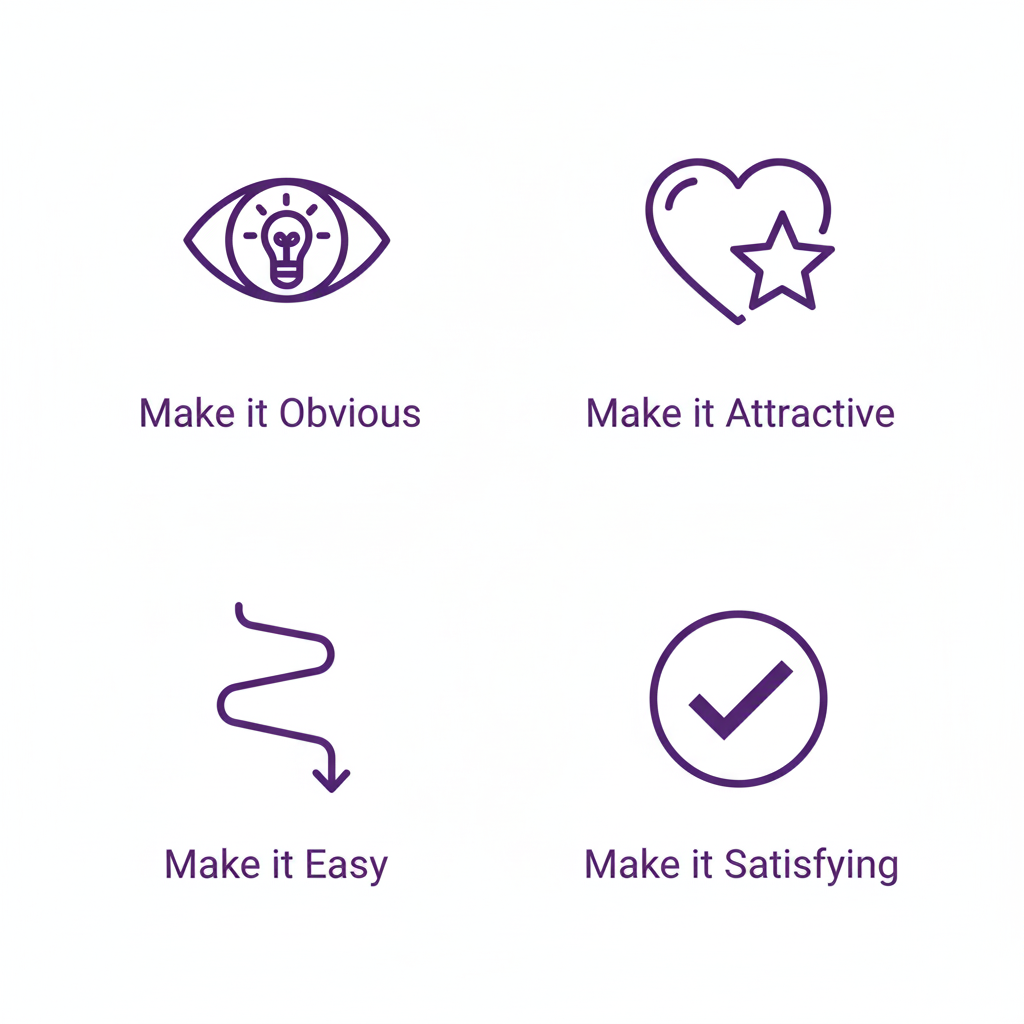
The 4 laws of habits formation
James Clear's Atomic Habits breaks down habit formation into four laws: make it obvious, make it attractive, make it easy, and make it satisfying. Let's adapt each one specifically for chronic pain management.
1) Make it obvious: implementation intentions for pain management
Vague intentions fail. "I should stretch more" relies on you remembering, having time, feeling motivated. That's three potential failure points before you even start.
Implementation intentions eliminate ambiguity. The format is simple: "After [CURRENT HABIT], I will [NEW HABIT]." You're linking the new behavior to an existing trigger that already happens automatically.
After I pour my morning coffee, I will do three gentle neck rolls. After I brush my teeth at night, I will practice 30 seconds of belly breathing. After I sit down at my desk, I will set a timer for a standing break in 45 minutes.
The specificity matters. Your brain doesn't have to decide when or where. The existing habit triggers the new behavior automatically.
You can also use environmental cues. Put your TENS unit next to where you sit in the evening. Leave your foam roller in the middle of your bedroom floor so you literally have to step over it. Fill water bottles and place them everywhere you spend time.
Make the helpful behavior so obvious you'd have to actively work to avoid it.
2) Make it attractive: temptation bundling
Most pain management strategies sound about as appealing as doing taxes. Pacing feels like deprivation. Gentle stretching feels like one more obligation. Heat therapy feels boring.
Temptation bundling pairs something you need to do with something you actually want to do. Your brain learns: this thing I'm ambivalent about comes with something I genuinely enjoy.
Only listen to your favorite podcast during gentle walks. Only watch that show you're hooked on while using your foam roller. Only have your special tea while practicing breathing exercises. Only scroll social media during your scheduled rest breaks (yes, you can make rest attractive too).
This isn't bribery. It's strategic pairing. You're creating positive associations with behaviors that might otherwise feel like chores. Over time, the habit itself becomes attractive because it's linked with something pleasurable.
3) Make it easy: the two-minute rule adapted for pain flares
Here's where most people sabotage themselves. They set the bar too high.
"I'm going to do 30 minutes of stretching every day" sounds admirable. It also sounds impossible when you're in a flare, exhausted, or just not feeling it. So you skip it. Then you skip it again. Soon you've abandoned it entirely.
Clear's two-minute rule says any habit should take less than two minutes to start. Not to complete. To start.
"Do physiotherapy exercises" becomes "get out the exercise sheet." "Practice better sleep hygiene" becomes "plug phone in across the room." "Manage pain proactively" becomes "take three deep breaths."
The goal is showing up. Starting is the hardest part of any habit. Make starting so easy you can't say no.
And here's critical for chronic pain: build in scaling. Your habit has three versions.
Minimal version (brutal pain days): Three breaths. One stretch. Put on walking shoes. Normal version (moderate days): Five minutes of gentle movement. Brief stretching routine. Expanded version (good days): Longer walk. Full stretching sequence. Extended practice.
You're never asking "should I do this today?" You're asking "which version am I doing today?" The habit stays intact even when your capacity varies wildly.
4) Make it satisfying: tracking without perfectionism
Your brain is wired for immediate gratification. The problem with most pain management strategies is that benefits show up weeks or months later. Too distant to motivate daily behavior.
Solution: create immediate satisfaction.
Habit tracking provides this. Put a checkmark on a calendar after completing your habit. Color in a box. Add a tally mark. That tiny hit of "I did it" becomes its own reward.
The visual also provides valuable information. You can see patterns. Notice that you consistently skip your habit on Tuesdays and realize that's your most demanding work day, so maybe you need a smaller version for Tuesdays. See that you maintained consistency through a pain flare by scaling down, which reinforces that flexibility works.
But here's the rule: never miss twice.
One missed day is life happening. Two consecutive missed days is the beginning of a new pattern you don't want. If you miss Monday, you show up Tuesday no matter what. Even if it's the absolute minimal version. Even if it's 30 seconds. You show up.
This isn't about perfection. It's about maintaining the identity: I am someone who shows up for myself, even in small ways, even on hard days.
The Four Laws of Habit Formation
Adapted for chronic pain management
Section 3: the replacement strategy
Why saying "stop catastrophizing" doesn't work
You've probably been told to stop catastrophizing about your pain. Stop thinking the worst. Stop spiraling into negative thought patterns.
How's that working out?
Here's why it doesn't work: you can't delete a neural pathway. Once your brain has learned a pattern, that wiring remains. When pain flares, catastrophic thoughts follow because that's the groove your brain has carved through repetition.
Telling yourself to stop thinking something is like telling yourself not to think about pink elephants. The instruction itself triggers the thought you're trying to avoid.
Studies on thought suppression show this clearly. People instructed to not think about white bears thought about white bears more than people given no instruction at all. Suppression backfires.
Your catastrophizing habit has a structure: cue (pain flare), routine (catastrophic thoughts), reward (sense of control through anticipating the worst, or sympathy from others, or permission to rest). You can't eliminate the cue. Pain will flare. You can't eliminate the need for the reward. You still need coping mechanisms.
But you can change the routine.
~
How to build competing habits that crowd out unhelpful patterns
Instead of trying to stop the unhelpful pattern, you build a new one that provides similar rewards but serves you better.
Same cue, different routine, similar reward.
Examples:
— Pain flares (cue), you practice paced breathing (routine), you feel more in control and less overwhelmed (reward).
— Pain flares (cue), you use your prepared self-compassion phrases (routine), you feel supported and validated (reward).
— Pain flares (cue), you engage in your planned distraction activity (routine), you get relief from pain focus (reward).
You're not erasing the catastrophizing pathway. You're building a competing pathway. With enough repetition, the new pathway becomes stronger, more automatic, easier to access. Your brain starts defaulting to it because it's the more reinforced pattern.
This takes time. The old pathway doesn't disappear. It's always there, especially under stress or when you're depleted. But the new pathway becomes your brain's first choice.
~
Real examples specific to chronic pain
Let's get concrete with patterns you might recognize and how to replace them.
Pattern: Pain flares, you immediately stop all activity and catastrophize. Replacement: Pain flares, you pause, take three breaths, then assess what gentle activity you can still do rather than stopping everything.
Pattern: You wake up in pain, immediately feel defeated about the whole day. Replacement: You wake up in pain, you say one neutral observation about it ("I'm noticing pain in my lower back today") rather than a judgment about what it means.
Pattern: Someone asks how you're doing, you launch into detailed pain descriptions that leave you feeling worse. Replacement: Someone asks how you're doing, you have a prepared brief response that acknowledges reality without dwelling ("managing, thanks for asking, how are you?") that lets you move the conversation forward.
Pattern: You have a good pain day, you overdo everything and pay for it tomorrow. Replacement: You have a good pain day, you still respect your pacing limits and enjoy sustained moderate activity rather than boom-bust.
Pattern: You compare yourself to old pre-pain you and feel grief and frustration. Replacement: You compare yourself to yesterday's you and notice what you're managing today that might have been harder last week.
Each replacement routine gets easier with repetition. You're literally building new neural pathways. The neuroscience is on your side once you stop trying to delete the old patterns and focus on reinforcing new ones.
Section 4: the never miss twice rule
Permission to be imperfect
Let's address the elephant in the room: you will mess up. You'll skip your habit. You'll have a week where everything falls apart. A pain flare will knock you sideways. Life will happen.
This is not failure. This is being human.
The never miss twice rule gives you permission to be imperfect while maintaining momentum. Missing one day is an accident, a necessity, a response to reality. Missing two consecutive days is the beginning of a new pattern.
When you miss Monday, you show up Tuesday. No matter what. Even if it's the absolute minimal version of your habit. Even if it's 30 seconds instead of 5 minutes. Even if it's putting on your walking shoes without actually walking.
You're maintaining the identity. I am someone who shows up for myself. That identity survives missed days as long as you don't miss twice in a row.
This takes the pressure off being perfect while keeping you accountable to consistency.
~
How to adjust habits during flares without abandoning them
Pain flares will disrupt your routines. That's not a possibility, it's a certainty. The question is how to maintain habits through disruption.
This is where having three versions of every habit becomes essential.
Your walking habit: Expanded version: 20-minute walk around the neighborhood. Normal version: 10-minute walk to the mailbox and back. Minimal version: Put on walking shoes and stand outside for 60 seconds.
During a flare, you drop to minimal version. You're not abandoning the habit. You're scaling it to match your current capacity.
This does two things. First, it maintains the neural pathway. You're still reinforcing the behavior pattern even in reduced form. Second, it protects your identity. You're still someone who moves their body, even when that movement looks drastically different.
The key is deciding in advance what your minimal version looks like. Don't wait until you're in a flare to figure it out. Define it now.
My stretching routine minimal version: one cat-cow stretch. My breathing practice minimal version: three conscious breaths. My pacing habit minimal version: set one timer for one break.
When the flare passes, you scale back up. But you never dropped to zero.
~
The difference between flexibility and giving up
Here's where people get confused. There's a difference between adapting to reality and abandoning your commitment.
Flexibility looks like: I planned to do my full routine but I'm in a flare, so I'm doing the minimal version instead.
Giving up looks like: I'm in a flare so I'm not doing anything, and I'll start again when I feel better.
Flexibility maintains the habit while adjusting the intensity. Giving up breaks the chain and requires starting over, which is harder than maintaining.
Flexibility also looks like: This habit isn't serving me anymore, so I'm replacing it with something more appropriate for where I am now.
Giving up looks like: This is too hard so I'm stopping without replacing it with anything else.
You're allowed to evolve your habits. You're allowed to change what you're working on. You're not locked into anything forever. But make those changes intentionally, not as a response to a temporary dip in motivation or a difficult week.
The question to ask: Am I adapting to meet myself where I am, or am I avoiding something uncomfortable?
Be honest with yourself. Both answers are okay, but they lead to different actions.
Conclusion: small votes for your future self
Every tiny action you take is a vote for the type of person you're becoming.
Do three neck rolls after your morning coffee? That's a vote for being someone who takes care of their body.
Practice 30 seconds of breathing during a pain flare? That's a vote for being someone who has tools to manage symptoms.
Rest when you need to rest, even when you feel pressure to push through? That's a vote for being someone who respects their limits.
You don't need to win every vote. You just need to win the majority.
The person you're becoming doesn't need you to be perfect. They don't need dramatic transformations or complete overhauls. They need you to show up, just one percent better than yesterday.
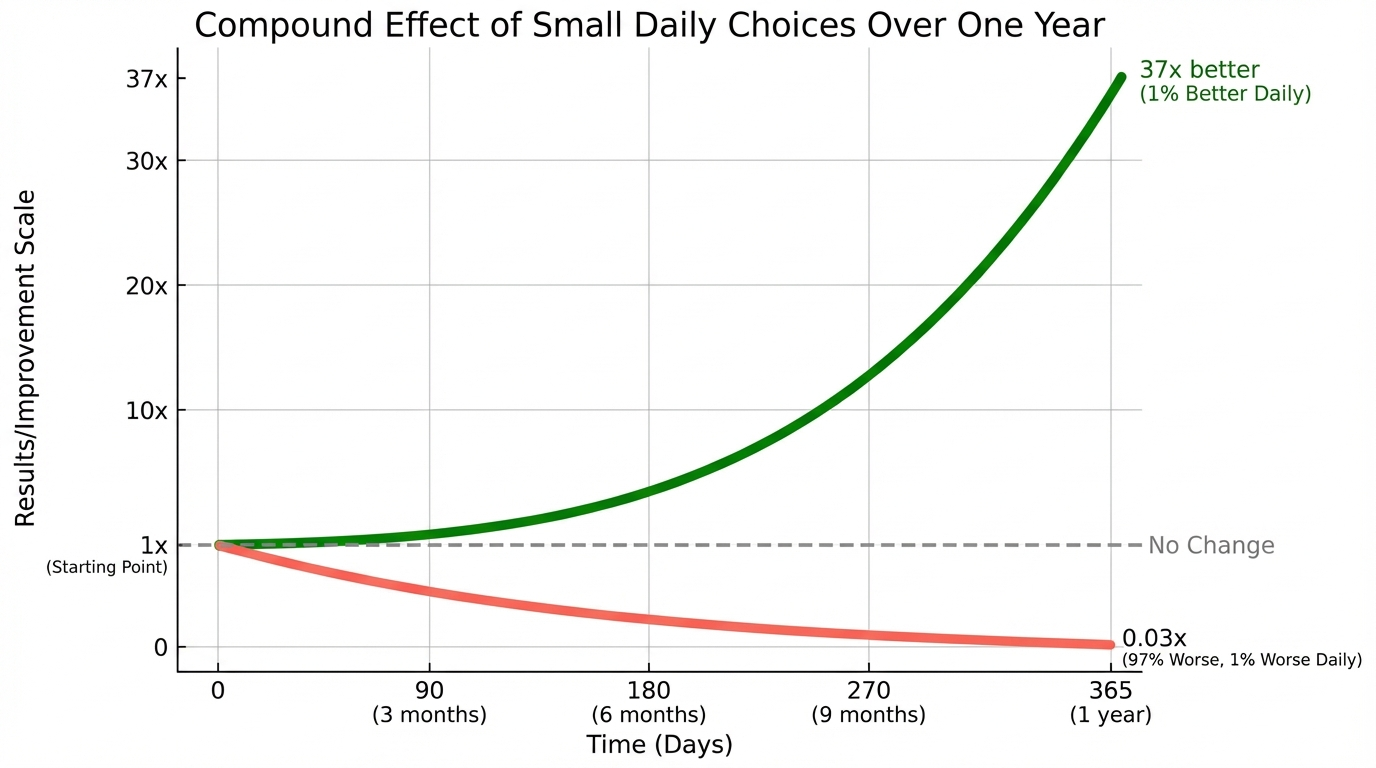
That's how real change happens. Not through willpower that eventually runs out. Not through motivation that fades when things get hard. Through tiny, consistent actions that compound over time into something meaningful.
Your nervous system is already working overtime. Give it the gift of automation. Build habits that serve you, and let them run in the background while you focus on actually living your life.
You're not broken, weak or lacking discipline. You're not failing at managing your life with pain properly.
Your current habits just aren't serving you. And now you know how to build better ones.
Start ridiculously small. One habit. Two minutes or less. Linked to something you already do.
The person you're becoming is waiting. 💜
References
Clear, James. Atomic Habits: An Easy & Proven Way to Build Good Habits & Break Bad Ones. Avery, 2018.
Baumeister, R.F., et al. "Ego Depletion: Is the Active Self a Limited Resource?" Journal of Personality and Social Psychology, vol. 74, no. 5, 1998, pp. 1252-1265.
Lally, P., et al. "How Are Habits Formed: Modelling Habit Formation in the Real World." European Journal of Social Psychology, vol. 40, no. 6, 2010, pp. 998-1009.
Eccleston, C., and Crombez, G. "Pain Demands Attention: A Cognitive-Affective Model of the Interruptive Function of Pain." Psychological Bulletin, vol. 125, no. 3, 1999, pp. 356-366.
