Vision boards for chronic pain: ditch the dream and build a system that works for 2026.
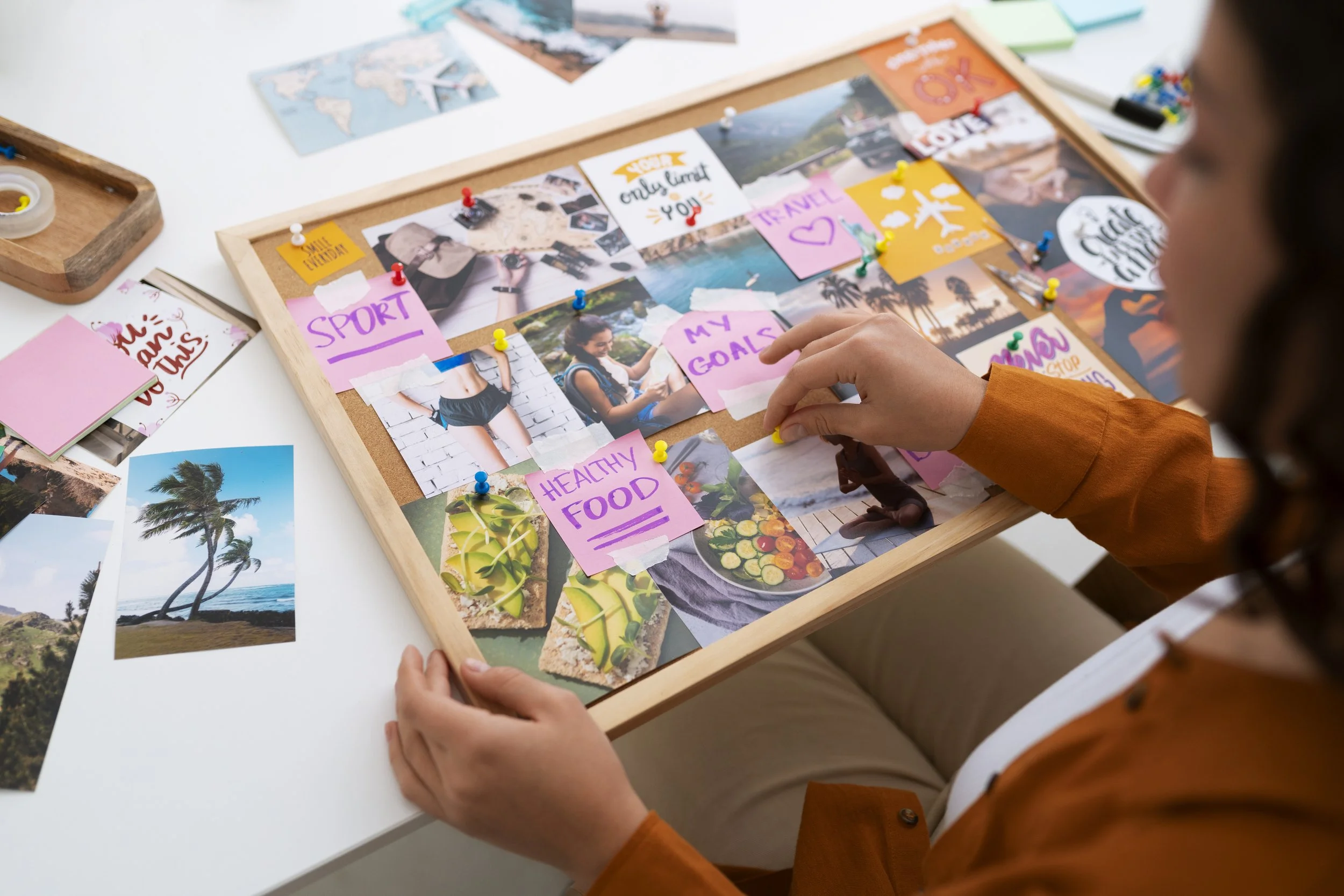
It’s 2026 and January, so two good reasons to talk about vision boards.
You’ve seen them everywhere. Instagram influencers swear by them.
That wellness guru in your feed claims hers manifested a beach house and perfect health. And maybe you’ve wondered: this doesn’t feel like me or my life because I already barely get outside or sleep at night!
So, you’re right, vision boards aren’t magic. But when done right, they’re not bullshit either and they might be another tool in your toolbox.
After years of working with chronic pain patients, I’ve learned something important: the difference between a vision board that helps and one that hurts comes down to how you build it. So let’s strip away the mystical nonsense and look at what actually would work in real life.
In this article:
• The science behind why vision boards can actually work (it’s about your brain, not the universe)
• Why the traditional approach fails people with chronic pain
• A simple three-zone framework that makes vision boards useful instead of frustrating
• Real examples you can copy
• The one thing that separates a helpful board from pretty wallpaper
• How this connects to our next article on Atomic Habits
The science behind the pretty pictures from Pinterest
Before you roll your eyes at another “manifestation” trend, consider this: your brain is wired to respond to visual cues.
Here’s what actually happens. When you repeatedly see images of things that matter to you, you activate your dopaminergic system, the brain’s motivation and reward pathway. This isn’t woo-woo, it’s neuroscience. Studies show that clear, visual goals activate attention networks in your brain, making you more likely to notice opportunities and take action toward those goals.
You could think of it like this: ever noticed how when you’re thinking about buying a red car, you suddenly see red cars everywhere? That’s your reticular activating system at work. So, a well-made vision board does the same thing for your health behaviors.
Don’t get me wrong, simply staring at pretty pictures doesn’t change anything. The magic isn’t in the board (even if your images are cute), it’s in what the board makes you do.
This is where most people get it wrong. And it’s where we’ll connect to the principles from James Clear’s Atomic Habits in our next article: small, consistent actions beat big, vague dreams every single time.
Why traditional vision boards fail people with chronic pain
I’ll be straight to the point : most vision boards set chronic pain patients up for failure.
Here’s the typical scenario (it’s just an example for illustration). Someone cuts out images of people running marathons. Adds inspirational quotes about “mind over matter.” Writes “PAIN FREE 2026!” across the top. Feels motivated for about three days. Has a pain flare. Feels like a failure. Shoves the board in a closet.
Sound familiar?
The problem isn’t the concept, it’s the execution. Traditional vision boards focus on outcomes you can’t directly control (being pain-free) instead of behaviors you can control (your daily responses to pain).
In chronic pain, this gap between fantasy and reality doesn’t just demotivate you. It can actually increase suffering through a mechanism called catastrophizing. When your board promises something impossible, every day you’re in pain feels like personal failure.
We can do better than that don’t you think?
The three-zone framework: building a vision board that actually works
Forget the magazine cutouts of people doing yoga on cliff edges. Here’s how to build a vision board that respects both science and your reality.
Zone 1: your core values (the why)
Start with what genuinely matters to you. That is the key! Not what you think should matter, not what Instagram says matters, but what lights you up 💡.
Examples:
• Deep connections with family regularly
• Independence in daily activities (cooking, laundry, groceries etc)
• Creative expression (writing, painting, playing an instrument etc)
• Walk on a regular basis, walk your dog
• Play with your kids, carry your grand kids
Action step: find 2-3 images that represent these values. A photo of your grandkids. Your garden. Your art supplies. Keep it personal and real.
The science: research in Acceptance and Commitment Therapy shows that connecting daily actions to core values significantly reduces pain-related distress. Values give you direction when pain tries to steal your compass.
——
Zone 2: SMART goals (the what)
This is where we get specific. Every goal needs five elements: specific, measurable, achievable, relevant, time-bound (SMART goals).
Bad goal: “Get more active” — Good goal: “Walk 10 minutes around my block, 5 days per week, for the next 3 weeks”
Bad goal: “Sleep better”. — Good goal: “Be in bed by 10 PM on weeknights, aiming for 7 hours of sleep, 4 nights out of 7”
Bad goal: “Less stress”. — Good goal: “Practice 10 minutes of guided breathing using my app, every night when I go to bed instead of scrolling, for 21 days”
Notice the difference? Good goals are so specific that you could track them on a calendar with yes/no checkmarks.
💡 The Atomic Habits connection: James Clear talks about making habits “obvious, attractive, easy, and satisfying.” Your SMART goals are the foundation, they make success measurable and trackable. More on this in our next article where we’ll dive deep into habit stacking for pain management.
——
Zone 3: daily actions (the how)
This is the most important zone, and the one most people skip.
For each goal, identify the specific actions that make it happen. Think of these as the tiny hinges that swing big doors.
Example for a walking goal:
Images and reminders on your board:
• Photo of your walking shoes by the door
• Reminder: “Shoes out = ready to go”
• Morning checklist: “Coffee, shoes, 10 minutes, done”
• Screenshot of your favorite walking route
Example for a sleep goal:
• Picture of your phone charging station (outside the bedroom)
• Evening routine flow: “9:30 PM wind down, lights dim, sleepy tea, bed by 10”
• Image representing your “no-screen zone” after 9 PM
Example for stress management:
• Screenshot of your breathing app
• Visual reminder: “3 morning minutes = calmer night/better morning”
• Cue image: your bed/pillow (your trigger to breathe)
Why this works: behavioral science shows that we don’t rise to the level of our goals, we fall to the level of our systems. Your board should make the system visible, not just the dream.
What to actually put on your board
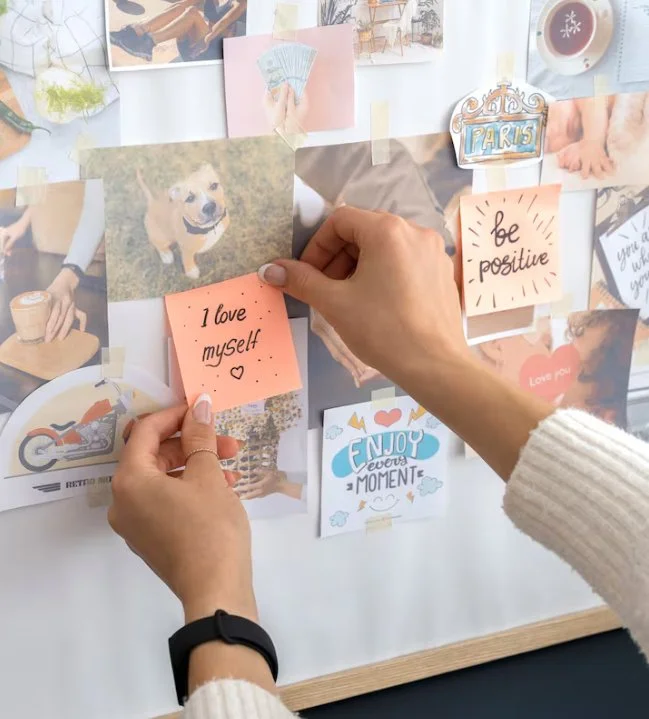
Let me show you what a realistic chronic pain vision board might look like for someone named Delilah.
Delilah’s values zone:
• Photo of her daughter
• Image of her painting supplies
• Picture of her book club friends
Delilah’s SMART goals zone:
• “Be in bed at 22:00, 4 nights/week, through February”
• “Chair yoga 15 min with YouTube tuto, 3 times per week for 4 weeks”
• “Daily pain journal, 2 minutes after breakfast”
Delilah’s actions zone:
• Bedroom photo with “Phone charges in kitchen” reminder
• Morning sequence: “Wake, journal, coffee, stretch”
• Screenshot of chair yoga video bookmarked
• Photo of her journal and favorite pen on the breakfast table
Delilah’s tracking zone (yes, add this):
• Simple calendar to check off completed actions
• Weekly review prompt: “What worked? What needs tweaking?”
What’s NOT on Sarah’s board:
• Pictures of pain-free people running half marathons or doing crossfits
• “No pain in 2026!” declarations
• Images that make her feel inadequate
• Anything requiring abilities she doesn’t currently have
The weekly review: where the magic actually happens
Here’s what separates a vision board from wallpaper: regular review and adjustment.
Every Sunday (or whatever day works), spend 10 minutes with your board and ask yourself:
1. Which actions did I complete this week?
2. What made it easier or harder?
3. What obstacles showed up?
4. Do I need to adjust anything?
5. What’s one thing I’ll keep doing?
This matters because chronic pain is unpredictable. A strategy that worked in January might need tweaking in February. Rigid plans break, flexible systems adapt.
Research on goal pursuit shows that regular monitoring increases achievement rates by up to 40%. But here’s the key: you’re not monitoring to judge yourself harshly, you’re monitoring to learn and adjust.
My tip : take a photo of your board each month. Watch how it evolves. Some goals will get checked off. Others will get modified. That’s not failure, that’s adaptive intelligence.
The Atomic Habits preview: tiny changes, remarkable results
Here’s where vision boards intersect beautifully with habit science (which we’ll explore in depth next time).
Your vision board makes your goals visible.Atomic Habits makes them inevitable.
Quick preview of what’s coming:
~ Habit stacking: “After I pour my morning coffee, I’ll do my 3-minute breathing practice”
~ Environment design: your vision board is literally environment design for motivation
~ The 2-minute rule: making habits so small you can’t say no
~ Identity-based habits: shifting from “I want this” to “I am someone who does this”
So, start thinking about this now: what’s ONE tiny behavior on your vision board that you could make so ridiculously easy that you’d feel silly NOT doing it?
That’s your entry point. That’s where transformation starts.
The ugly truth about vision boards and chronic pain
No, a vision board won’t cure your pain. It won’t make bad days disappear. It won’t replace your treatment team, your medications, or your therapy.
What it can do:
Remind you what you’re working toward when pain tries to steal your focus. Make helpful behaviors more automatic through visual cuing. Give you concrete wins to celebrate when big goals feel far away. Keep your values front and center when pain tries to shrink your world. Provide a roadmap for days when decision fatigue makes everything harder.
The research is clear: people with chronic pain who maintain a sense of purpose, who have clear action plans, and who track small wins consistently report better quality of life. Not because their pain disappeared, but because they learned to build a meaningful life alongside their pain.
Your vision board is a tool for that building process.
Your action plan: start now (even if we are in April or October!)
This week:
1. Grab a poster board, corkboard, or even a page in your notebook
2. Write down 2-3 core values (zone 1)
3. Choose ONE SMART goal to start (zone 2)
4. Identify 2-3 specific actions for that goal (zone 3)
5. Put your board somewhere you’ll see it daily
Next week:
• Track your actions (check marks are fine)
• Notice what works and what doesn’t
• Adjust without judgment
In 3 weeks:
• Do your first review, but be kind to yourself.
• Consider adding a second goal if the first is rolling
• Read our next article on Atomic Habits for chronic pain
Our Conclusion
Vision boards aren’t magic, but they’re not useless either.
The difference is this: effective vision boards don’t show you what to wish for, they show you what to do next.
In a world of chronic pain where so much feels outside your control, this matters. You can’t control your pain levels tomorrow. But you can control whether you put your walking shoes by the door tonight. You can control whether you set your phone to charge in the kitchen. You can control those three minutes of breathing after your morning coffee.
String enough of those controlled moments together, and you’ve built something real: not a pain-free life, but a life worth living despite the pain.
And honestly? That’s better than any Pinterest board promised anyway.
Next up: Atomic Habits for chronic pain: the 1% better strategy that actually works. We’ll dive deep into the habit science that makes your vision board come alive.
Want to share your vision board progress? I’d love to hear what’s working (and what’s not) in the comments below. Real stories from real people beat inspirational quotes every time.
Remember: you’re not trying to manifest a miracle. You’re building a system. Small steps, real progress, sustainable change. I’m proud of you, so should you.
Let’s do this. 💪
